
 Abraham Hyatt
Planes get knocked off workbenches. They get banged into other tools. They need to be strong and durable. So for a couple of 19th century inventors, an obvious improvement was to make them out of glass.
In the late 1980s, several historians, including Charles F. Hummel, were exploring the collections at Pennsylvania’s Old Economy Village when they discovered a surprising tool: a croze with glass inset into the face. (A croze plane cuts the groove in the interior of a barrel that the lid or bottom sits in.) Behind the glass was a label with the makers’ names, Young, Bagg[s] & Co, and a patent date. Glass as a wear surface isn’t necessarily a bad idea. As Hummel put it, “Glass would be dimensionally stable with little or no expansion or contraction. It, therefore, might be more accurate and less likely to cause binding in use.”1
But the April, 1874, patent the croze was based on was not for a glass-faced croze. The patent was for a croze made entirely of a single, molded piece of glass. The inventor, John W. Young, was Andrew H. Baggs’s business partner in a foundry in Wheeling, West Virginia. Baggs also ran the La Belle Glass Works in Bridgeport, Ohio, across the Ohio River from Wheeling.2
 The Young, Baggs & Co. glass-faced croze. Source: The Chronicle.
In a series of breathless articles extolling the virtues of Young and Baggs’s planes, Wheeling’s newspapers came to the same conclusion as Hummel: glass made for a more dimensionally stable face. Initially, the men wanted to make all kinds of planes before narrowing their focus to coopering tools. It’s unclear which planes were to be glass-faced and which were all glass. According to the Daily Register, “The cooper’s levers and floats are faced with glass; the stalk howl guards are also faced with glass, the board being entirely of glass. All kind and sizes of crows are made entirely of glass.”3
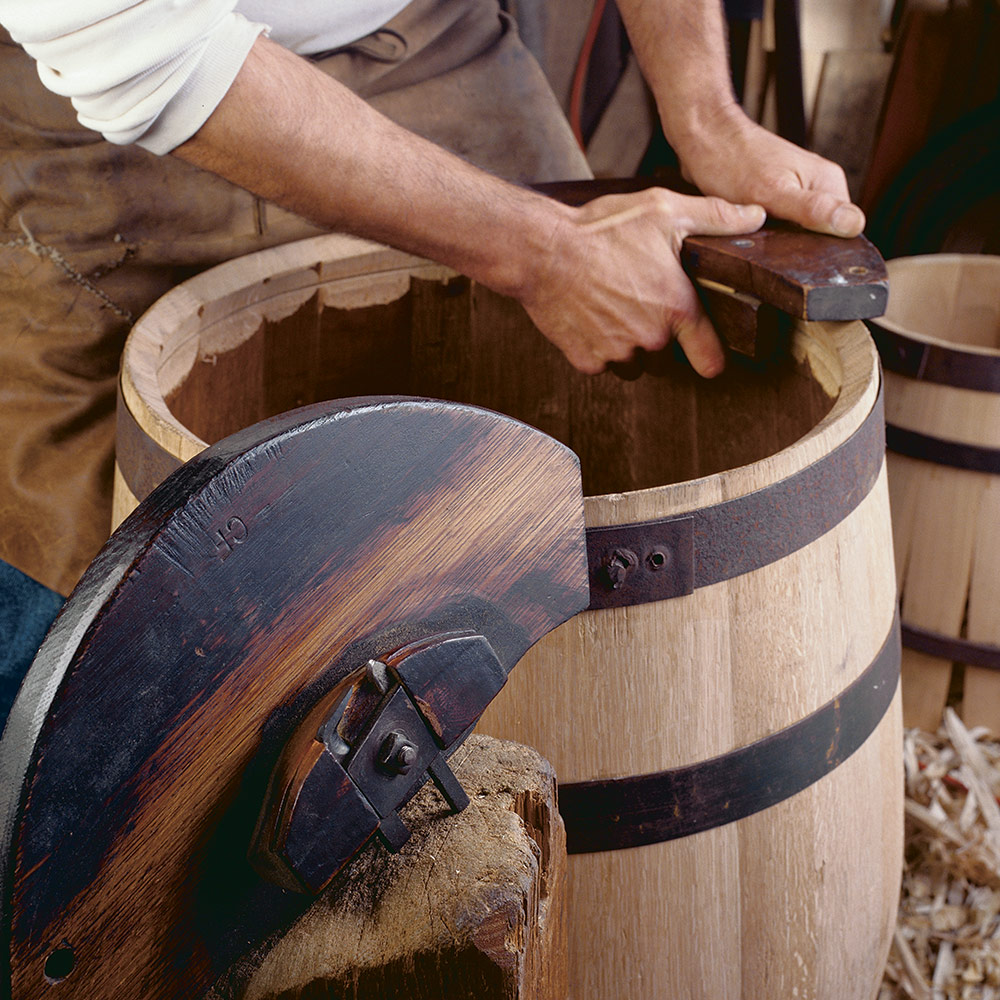
The croze is not a delicate plane. Cutting the groove is rough work, as you can see here. The plane is subject to all kinds of internal forces as it bangs across the staves. If it’s made entirely of glass and breaks while you’re using it, there’s a real risk of a horrible cutting injury. A deep wound in the pre-antibiotic age could be a death sentence. A glass-faced version is perhaps safer, but the plane becomes useless if the face cracks or breaks and the glass falls out. Glass was a terrible solution in search of a non-existent problem.
Despite the claim that the men were building another furnace due to the “unexampled success with which they have met in the short time they have been in operation,” it doesn’t seem like anyone outside of Wheeling and Bridgeport knew these tools existed. Or at least I can’t find any mentions in other newspapers and books.4
 John B. Thomas's patent for a glass bottom plane.
Young wasn’t the only inventor bold (crazy?) enough to see glass as a viable material. John B. Thomas, from Cincinnati, Ohio, patented a glass bottom smoothing plane in March 1856. His idea called for molten glass, 1/2 to 3/4 inches thick, to be poured into a metal frame. Once it had cooled, the wood part of the plane would be screwed into the frame. What Thomas’s patent fails to address is, how the heck do you create the mouth and throat? As far as I know, there are no examples of his plane.
I know other tool researchers have recently become interested in Young and Baggs planes again. Does this mean someone’s found another glass plane? Or did they all shatter on a workshop floor long ago?
Interested in more stories about unusual planes?

- Who Stole This Solid Ivory Plow Plane?
- 'A man of rare ability and taste': A Legendary Gunsmith's Personal Gunstocker Plane
- Glass Has to be the Worst Material to Make a Plane From
- Dyed With English Dragon's Blood
- The Tiniest Planes You'll Never Use
I am a good and well made plain
 Source: Milton Bacheller/The Chronicle.
LIBER
I AM A GOOD AND WELL MADE PLAIN
CHARLES DUPEE IS MY MASTERS NAM[E]
HE IS THE MAN THAT FORMED ME
HIS FAITHFULL SERVANT I WILL BE
FEB 27 1787
There are a few known examples of planemakers personalizing their own planes, but I don’t know if we’ll ever find something else like this jointer. Charles Dupee was an “inn holder” who also worked as a planemaker in Southern Massachusetts between 1755 and the late 1880s. (There’s a story that Nathan Hale’s company ate breakfast at his tavern on its way to fight in the siege of Boston in 1775.) This 36-inch-long jointer was made during the latter part of Dupee’s working period. The C and D are each engraved, respectively, with his first and last name. It’s the pewter plate behind the broken tote that’s most remarkable. Beginning with the Latin word “liber” (in this context likely meaning free) the impeccable lettering spells out a message from the plane to its maker. It is, as historian Patrick Lasswell described it, “an extraordinary inscription on an extraordinary plane.”5
 Source: Milton Bacheller/The Chronicle.
-
Charles Reichman, “Young, Bagge & Co and the Glass-faced Croze,” The Chronicle 41 no. 4 (1988): 80 ↩
-
business partner: Seán P. Duffy, “83 Years Of Molding America: Remembering Wheeling’s Real Ironmen,” Upper Ohio Valley Historical Review 44 no. 1 (Summer/Fall 2024) 39. La Belle Glass Works: “Valuable Inventions,” Wheeling [West Virginia] Daily Register, January 15, 1875, 4. ↩
-
“Inventions” 4. See also “Proved to be a Success,” Wheeling [West Virginia] Daily Intelligencer, May 14, 1875, 4; “Glass Tools,” Wheeling [West Virginia] Daily Intelligencer, August 18, 1874, 4; and “Young’s Glass Croze,” Wheeling [West Virginia] Daily Register, April 13, 1875, 4. ↩
-
“Inventions” 4. ↩
-
For more on the Charles Dupee jointer, see Patrick Lasswell, “Charles Dupee’s Jointer,” Sign of the Jointer 2 no. 2 (Summer 2000) 59-61, and Tom Elliott, “Joshua Clapp/Clap and Charles Dupee, Planemakers and Patriots of the American Revolution,” The Chronicle 67 no. 1 (March, 2014) 35-36. ↩