
 Abraham Hyatt
 Dublin A. Source: Lang/Viking-Age Decorated Wood.
The medieval sailors, raiders, and merchants we know as the Vikings left behind ample evidence of their woodworking skills, from shipbuilding to carving. So it would seem obvious that the plane was well-known in Norse culture. And indeed, you can find the word for plane, lokarr, and variations of the word for plane shavings, lokar-spánn, in both sagas and poetry. 1
The Edda, an early 13th century Icelandic text, tells the story of a fight between the Æsir, the Norse gods, and a giant who turns himself into an eagle. When the gods see the eagle approaching, they carry “burdens of plane-shavings” into Asgard, the mythical home of the Æsir. As the eagle swoops down, they set fire to the shavings. The flames burn the eagle’s feathers, and the gods attack and kill it. 2
In Fornmanna Sögur, the saga of a Norwegian king who ruled from 995 to 1000, an earl demands restitution from a group of sailors who accidentally sank a warship he commanded. “When they come,” the earl says, “to pay the fines … they will think, I fancy, that my plane is greedy of shavings.” (It’s also been translated as “they will think my plane cuts no thin shavings in the matter of fees.”) In Þiðreks saga af Bern, a handsome knight has hair and beard “as golden as silk and as curly as plane shavings.” My favorite comes from the Icelandic poet Hallar-Steinn (active circa 1200) who compares writing a poem to building a ship. The bow, or beginning of the poem, he writes, is smoothed by the tongue, “the plane of poetry.” 3
But despite these literary examples, there’s little physical evidence from their ships and homes that the Vikings actually used planes. There are only two known Viking-era planes, both found in Dublin, Ireland, in the 1970s. The planes, which I’ll refer to as Dublin A and Dublin B, were excavated from an area the Vikings occupied from 917 AD to around 1170 AD.
 Dublin A. Source: Thomas Baurley, Eadaoin Bineid, Leaf McGowan, Technogypsie Productions
Dublin A was found in an antler waste area under a house dated to the mid 11th century. It’s a complete plane, about 16 inches long, with a flat sole. It’s made of an unknown wood and has animal head terminals with sharp snouts, pricked ears, and incised eyes. It was found with its iron (see top image). The pin that holds the iron in place is set very close to the back of the throat. The wedge must have been made of a very thin material, maybe metal or bone. And the throat opening is about 2 in/5 cm long. If you used Dublin A like a modern plane, you’d end up with significant tear-out. 4
 Dublin B. Illustrations: Lang/Viking-Age Decorated Wood. Source: Breandán Ó Ríordáin, "The High Street Excavations" in Proceedings of the Seventh Viking Congress, ed. Bo Almquist and David Greene (Royal Irish Academy, 1976) 147.
Dublin B was found in a wood chip area dated to the late 11th century. It’s a fragment about 4 in/10.5 cm long, made of spindle wood with a flat sole. Its animal head terminal is much cruder than Dublin A. It’s inscribed with Norse runes on both sides. 5
Both Dublin A and B are what are sometimes called “ship-like” planes, a style that emerged briefly in Northern Europe as the Roman Empire faded. All of the ship-like planes I’ve been able to track down are hundreds of years older than their Dublin counterparts. Two of the best-known are part of an extensive war booty sacrifice deposited in the Vimose bog on the Danish island of Funen between 200 AD and 250 AD. Both have concave soles and may have been used to make spears or arrows. One of the Vimose planes is inscribed with West Germanic runes. The inscription is only partially visible. Some sources read one of the runes as taljio, a possible word for plane. But others, like the historian and linguist Bernard Mees, think it’s more likely the runes were used to invoke some type of ritual protection. Mees describes the Vimose plane runes as “magico-religious text.” 6
 Ship-like planes. Top left: Vimose bog, Denmark, possibly boxwood, c. 200-250 AD, 10.2 in/25.8 cm long, The Chronicle: Top right: Nydam bog, Denmark, unknown wood and size, c. 250-550 AD, National Museum of Denmark. Bottom left: Vimose bog, Denmark, ash, c. 200-250 AD, estimated full size 11.8 in/30 cm long, National Museum of Denmark. Bottom right: Likely Scandinavian, unknown wood and size, 250-400 AD, Saint Thomas Guild.
The runic inscription on Dublin B is Norse. It’s been translated as either “he is a mad, vehement man among the…” or “a truthful man among the Frisians.” The first thing I thought of when I read that second translation are the early medieval-era planes found in the Dutch province of Friesland. The planes were excavated from the large artificial mounds, or terps, that Frisians settlements were built on. But the Frisian planes have nothing in common with ship-like planes. They’re Roman-influenced, with square bodies and a rear tote. And they’re all centuries older than the Dublin planes. (It’s also worth noting that the Frisians defeated the Vikings in a famous battle in 884.) 7
An obvious place to look for evidence of Viking planes is the remains of their ships. I want to start with the five ships scuttled in a waterway near Skuldelev, Denmark in the 11th century. One of the ships, Skuldelev 2, was built in or near Dublin in 1042, which makes it the same age as Dublin A.
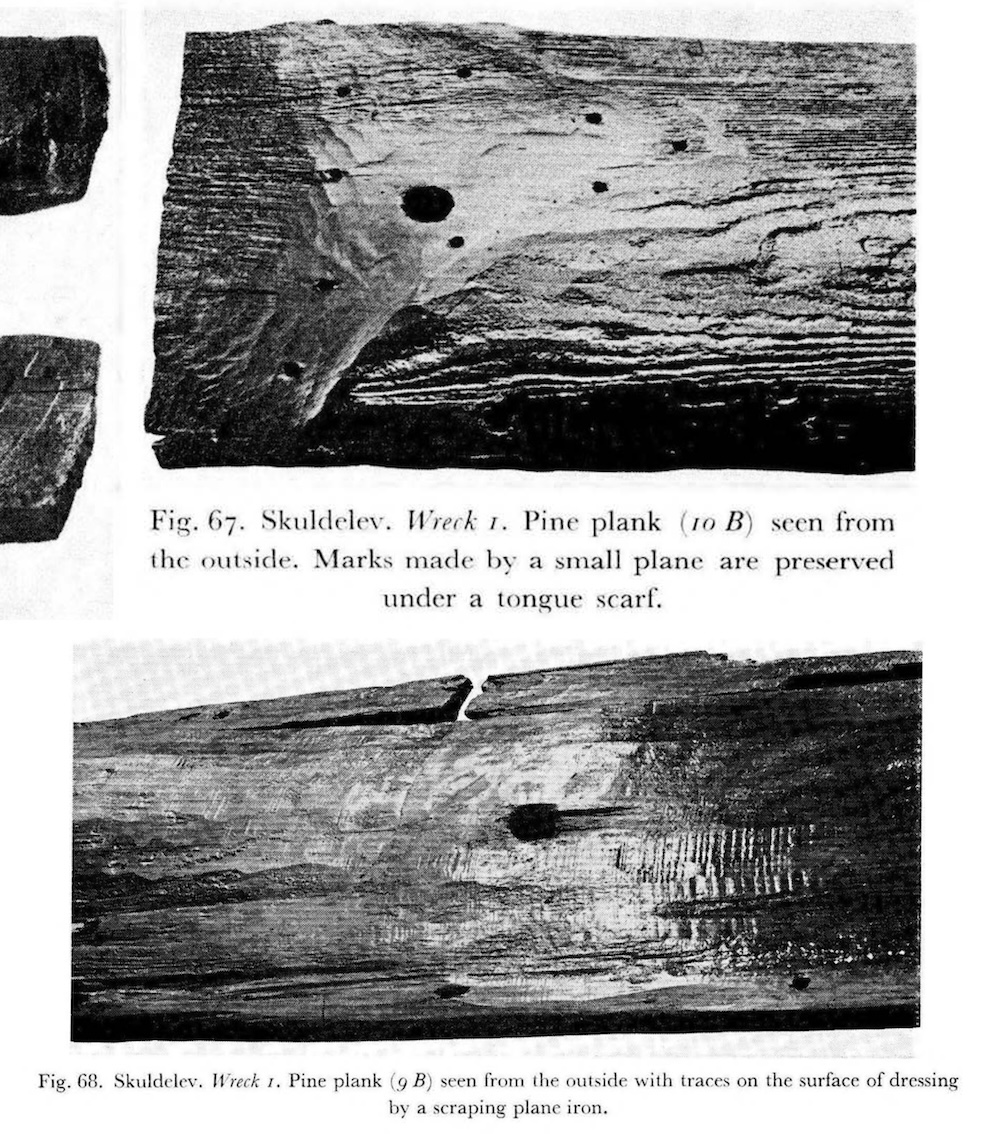
In a 1967 report on the excavation of the Skuldelev ships, archaeologist Ole Crumlin-Pedersen (who would later go on to found Denmark’s Viking Ship Museum) writes that “plane traces” were found on a scarf joint and on the planks of Skuldelev 1. His explanation leaves me with more questions than answers. He confusingly conflates smoothing and scraping when he describes the marks: “The traces of strippers (plane irons) or similar tools, that can both cut and scrape, used for dressing the surface of the wood, were found on most of the pine planks.” In the accompanying photo he attributes the traces to a “scraping plane iron.” What type of tool is he thinking of? He speculates the tool was, “presumably pulled towards the user, as opposed to a plane.” 8
Interested in more stories about ancient woodworking?

- Roman Soldiers and Their Moulding Planes
- Blame This Famous Book for the Myth That Ancient Egyptians Used Planes
- If the Vikings Didn't Use Planes, Why Did They Write Poems About Them?
- Rhyken: Did the Ancient Greeks Really Have a Word For 'Plane'?
- What Ancient Hand Tools Do to Our Emotions
- Planes on Roman Coins and Sticking Crown Molding
- A Brief History of Chinese Plane Making
The only finishing tool Norse boatbuilders used that was pulled towards the user was the shave, the predecessor of the spokeshave. The shave has handles that are perpendicular to the blade (see illustration below), and is pulled across the surface of the wood. In 1982, Arne Emil Christensen, former head of the Viking Ship Museum, compiled a list of known Norse shipbuilding tools. He came to conclusion that the plane was not one of them. When he revisited the topic more than 25 years later, after reviewing replica ships and hundreds of tools found in Norse burials, he came to the same conclusion: Planes, and specifically Dublin A-type planes, were probably not used in shipbuilding. 9
There’s one more piece of research I want to point out, and it comes from experimental archaeologists at the Viking Ship Museum. They noticed plane-like tool marks on a boat dated to 1025, known as Roskilde 6, that was found about 12 miles away from the Skuldelev ships. The shipbuilders made a “slightly scaled-up copy,” as they described it, of Dublin A with an iron the same width as the marks. While the marks from their plane matched the pattern left on original planks, they also found that the plane’s large mouth, unsurprisingly, created extensive tear-out, which was not found on the original. 10
 Top: Two shaves without their wooden handles found in Norwegian Viking Age graves. Illustrations: Christensen/Woodworking Techniques before A.D. 1500. Bottom left: Tool marks on a Roskilde 6 plank. Bottom right: Marks left by a Dublin A replica. Deep tear-out can be seen along the length of the marks. Photos: Connected by the Sea.
It’s almost certain Dublin A and B weren’t used in home construction. Nearly all the buildings in 11th century Viking Dublin were made of low post and wattle walls with rounded corners and thatched roofs supported by rough-hewn squared posts and beams. Finishing was done with an axe. (It’s possibly noteworthy that Dublin A was found in one of the few homes that used slightly more complicated building techniques, with walls made of grooved staves and drilled baseplates.) Medieval native Irish builders were adept joiners. Evidence of mortise and tenons, housed dovetails, and rabbets have been found throughout Ireland. Viking carpenters, on the other hand, appear to have been content with their axes. 11
Patrick Wallace, who led some of the Viking Dublin excavations before going on to serve as the director of the National Museum of Ireland, is baffled why local Norse carpentry remained so rudimentary for so long. “This situation is all the more strange,” he writes, “when the high standards of other crafts in wood including carving, coopering and possibly ship-building then available in Dublin are considered.” He continues, “It seems as if woodcarvers, turners, coopers and craftsmen working in smaller wooden objects possessed techniques which either remained unknown to the carpenter or were not considered a necessary acquisition to the contemporary repertoire.” 12
The Dublin planes must have been used for something. Arne Emil Christensen has a hypothesis that they were used to joint thin boards that would be glued together, possibly for shields. A few years back, Dennis Riley with Daegrad Tools in Sheffield, England, made a reproduction of Dublin A. His brief video showcasing the plane lends a little credence to that hypothesis, but I can’t tell what type of finish it left. The plane sounds pretty rough. 13
The discrepancy between the planes in Norse prose and poetry and the lack of physical evidence raises so many unanswerable questions: What planes were producing so many shavings they were known as a common fire starter? If Dublin A only makes coarse shavings due to its elongated mouth, what planes were making thin shavings? And if there’s no evidence of planes being used in shipbuilding, then why would the poet Hallar-Steinn use them as a shipbuilding metaphor!
 Possible runic inscription for lokarr in Younger Futhark, an alphabet used during the Viking Era. Source: oldnorsedictionary.com
Like what you read?
Send this newsletter to a friend!
And sign up so you don't miss future stories.
-
Richard Cleasby and Gudbrand Vigfusson, Αn Icelandic-English Dictionary, (Oxford at the Clarendon Press, 1874) 397. ↩
-
For translations of the Edda that use “plane shavings,” see Rasmus B. Anderson, trans., The Younger Edda: Also Called Snorre’s Edda, or the Prose Edda (Griggs. 1880) 157, and Arthur Gilchrist Brodeur, trans., The Prose Edda (American-Scandinavian Foundation, 1916). Several translations of the Edda use “wood shaving” instead of “plane shaving,” for instance, Anthony Faulkes, trans., Edda (Everyman, 1995) 60, and Heimir Pálsson, ed., The Uppsala Edda: DG 11 4to (The Viking Society for Northern Research, 2012) 87, which is also translated by Faulkes. However, the three original texts that I referenced — Edda Snorra Sturlusonar: með skáldatali (1935), Edda Snorra Sturlusonar: eða Gylfaginníng, Skáldskaparmál og Háttatal (1848), and Skáldskaparmál 1: Introduction, text and notes, (1998) — all use plane shaving. ↩
-
When they come: J. Sephton, trans., The Saga Of King Olaf Tryggwason (David Nutt, 1895), 252. they will think: Cleasby, Dictionary, 397. as golden as silk: Edward R. Haymes, trans., The Saga of Thidrek of Bern (Garland Publishing, 1988) 16. plane of poetry: Edith Marold, ed., “Hallar-Steinn, Fragments 5” in Kari Ellen Gade and Edith Marold, eds., Poetry from Treatises on Poetics (Brepols), 206, accessed Nov. 1, 2024, https://skaldic.org/m.php?p=verse&i=3034. ↩
-
James T. Lang, Viking-Age Decorated Wood (Royal Irish Academy, 1988) 33, 85. ↩
-
Lang, Decorated Wood, 5, 79. ↩
-
a possible word: Arne Emil Christensen, “The Roman Iron Age Tools From Vimose, Denmark,” Acta Archaeologica 76, (2005): 75. historian and linguist … magico-religious text: Bernard Mees, “The Noleby inscription and Germanic rehaną,” Arkiv för Nordic Filologi (2018): 133. For another argument in favor of the runes as protection, see Carl Marstrander, “De nordiske runeinnskrifter i eldre alfabet,” Viking 16 (1953), as cited in Christensen, Roman Iron Age Tools. ↩
-
translated as: Catherine Estelle Johnson, “A Comparative Study of Portable Inscribed Objects from Britain and Ireland, AD 400-1100” (PhD diss., University of Glasgow, 2019) 107. medieval-era planes: William Goodman, The History of Woodworking Tools (Bell & Hyman, 1978) 54-55. ↩
-
Ole Crumlin-Pedersen and Olaf Olsen, “The Skuldelev Ships - A Report of the Final Underwater Excavation in 1959 and the Salvaging Operation in 1962,” Acta Archaeologica 38 (1968): 160-161. ↩
-
only finishing tool: See Sean McGrail, Ancient Boats in North-West Europe, (Routledge, 2014) 155, and Arne Emil Christensen, “Recreating Two Early-Norse Tool-Chests,” The International Journal of Nautical Archaeology 37.1 (2008): 179. handle: Salaman, in his Dictionary of Tools, and Christensen, “Early-Norse Tool-Chests”, 181, have examples of how the Norse shaves in the illustration could have had a single handle. The fact that they would be drawn towards the user remains the same. In 1982: Arne Emil Christensen, “Viking Age Boatbuilding Tools,” in Woodworking Techniques Before A.D. 1500 ed. Sean McGrail (B.A.R. 1982), 327-337. When he revisited: Christensen, Early-Norse Tool-Chests, 179–180. ↩
-
Thomas Finderup, “History written in tool marks,” in Connected By the Sea - Proceedings of the Tenth International Symposium on Boat and Ship Archaeology ed. Lucy Blue et al (Oxbow Books, 2006), 21-26. ↩
-
Nearly all the buildings: Patrick F. Wallace, The Viking Age Buildings of Dublin (Royal Irish Academy, 1992) 45. Finishing was done: Spoon bits (ranging from 7/32 in (1.5 cm) to 1 3/8 in (3.5 cm)) and chisels were also occasionally used. See Wallace, Viking Age Buildings, 43. adept joiners: Patrick F. Wallace, “Carpentry In Ireland A.D 900-1300 — The Wood Quay Evidence,” in Woodworking Techniques Before A.D. 1500 ed. Sean McGrail (B.A.R. 1982), 264-265. ↩
-
Wallace, “Carpentry In Ireland”, 271, 272. ↩
-
hypothesis: See Christensen in both “Roman Iron Age Tools”, 66, and “Early-Norse Tool-Chests”, 179. ↩