
 Abraham Hyatt
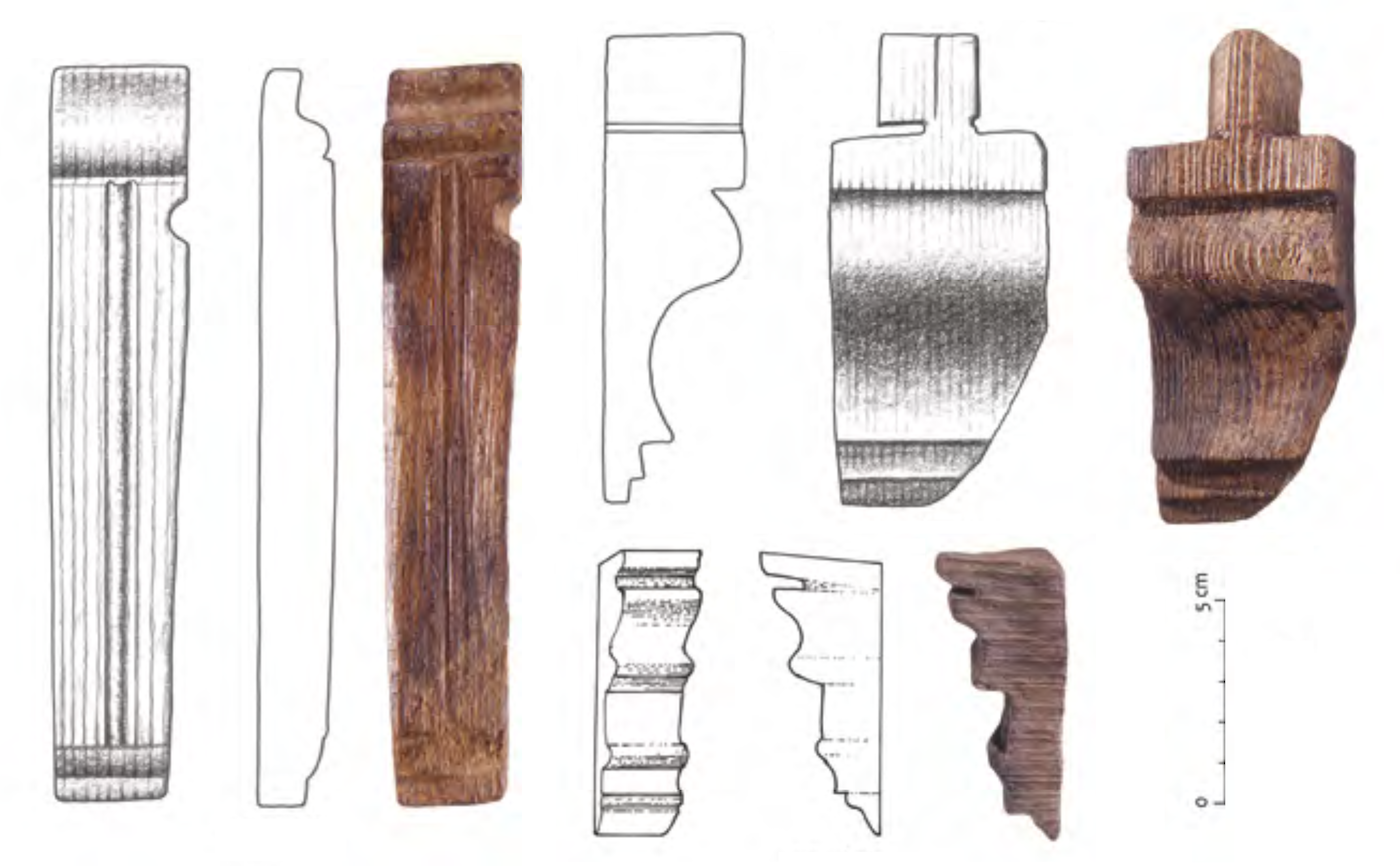 Moulding offcuts and fragments found at Velsen 1, Images: See note #1.
 As the Romans expanded their empire into the wilds of present-day Germany, the UK, and the Netherlands in the first century AD, they brought their taste in fine furniture with them. And that taste required specialty tools. Some of the most common woodworking tools found in the ruins of Roman military forts are joinery and moulding plane irons.
The best examples of moulding irons come from four forts: Saalburg, Zugmantel, Vindolanda, and Trimontium. Saalburg and Zugmantel (AD 90-260) were part of the Germanic Limes, a series of frontier forts on the empire’s northern border. Vindolanda (AD 85-370) was built along Hadrian’s Wall in northern England. Trimontium (AD 79-184) was located southeast of Edinburgh, Scotland.
More clues about mouldings on the frontiers comes from two forts, named Velsen 1 and Velsen 2 by modern archaeologist, located about 12.5 miles/20 kilometers northwest of Amsterdam. While no plane irons have been found, copious wood waste confirms the type of fine woodworking done there. Wood specialist Silke Lange, who inventoried nearly 1,600 wooden objects at Velsen 1, writes that “the moulding plane certainly belonged to the toolbox of the carpenters working in the fort, considering the numbers of decoratively profiled slats, planks, and battens which were used for all kinds of applications, including the decorative finishing of the tops of doors, cupboards, and wall racks.”1
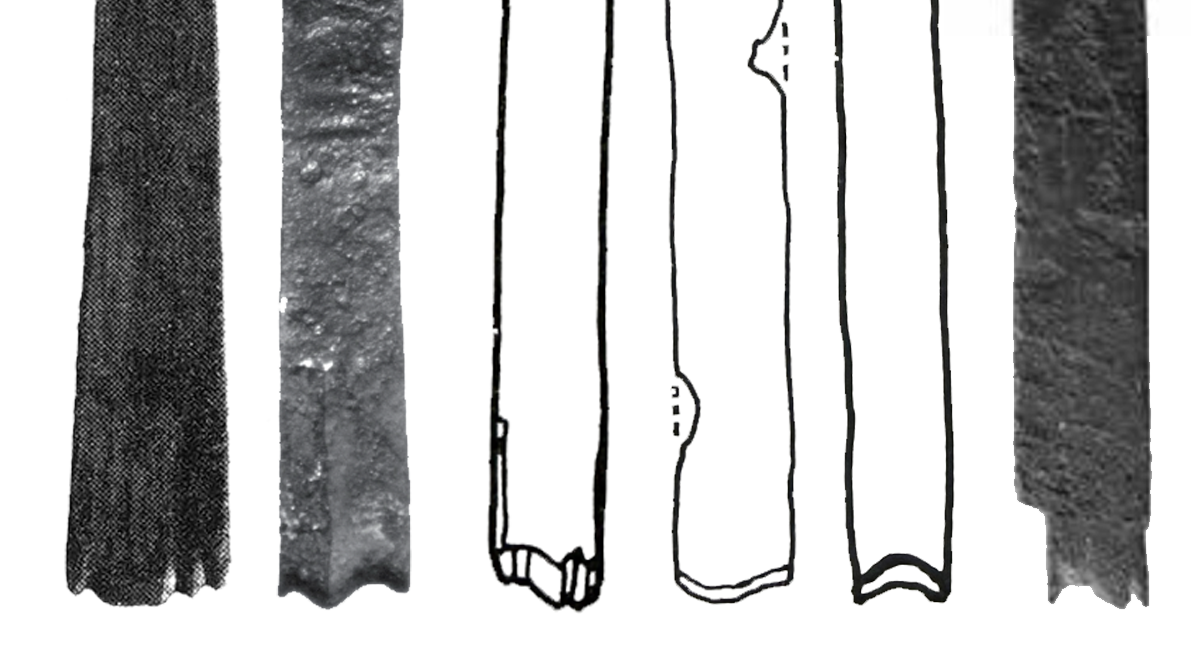 Moulding plane irons found at, from left, Trimontium (Scotland), Vindolanda (England), Saalburg (Germany), Saalburg (Germany), Zugmantel (Germany), and London (England). The London iron is not from a fort. See below for image credits, dimensions, and sharpening angles.
So who were the soldiers who used moulding planes? In the Roman civilian world, fine woodworking was done by the enslaved, freed slaves, and freeborn landless commoners, likely in small workshops where skills (and craft secrets) were passed down from father to son, or taught by a master-craftsman to an apprentice. Roger Ulrich, author of the excellent book Roman Woodworking, believes that those who did interior woodwork (faber intestinarius) were men “with many years of training and a collection of specialized hand-tools such as fine-toothed saws and molding planes.” Joinery work was so specialized that it’s likely a craftsman would have focused on making a single object or a related group of objects. A chest maker, or arcularius, would have also made clothes cabinets and other box-like furniture.2
In the military, woodworkers were part of the immunes, soldiers with specialized skills who were exempt from routine tasks and hard labor. Based on the range of tools found at Saalburg, carpentry and joinery were distinct lines of work. It’s unclear what overlap there was between men who brought woodworking skills with them to the army and those who were trained after enlistment or conscription. In the civilian world, highly specific distinctions were made between different woodworkers (i.e. wagon maker, faber plaustrarius; cart maker, faber carpentarius; comb maker, faber pectinarius; bed and couch maker, faber lectarius), but I don’t know if those delineations were also found in the military.3
Carpenters and joiners worked alongside smiths, masons, armorers, and other craftsmen in shops called fabricae, which could be very large. At Vindolanda, period records show 343 men working in a fabricae in a single day. While there’s evidence that some prefabricated furniture parts were imported from elsewhere in the empire, the amount of offcuts and waste from furniture making and other light woodworking at Velsen 1 show that much of the work was done onsite by soldiers. The archaeologist Martin Pietsch, who inventoried thousands of tools from Saalburg and Zugmantel, found that the majority of plane irons of all types at those forts date to the middle Imperial Period, with half as many from the early period. Few late Imperial irons have been found.4
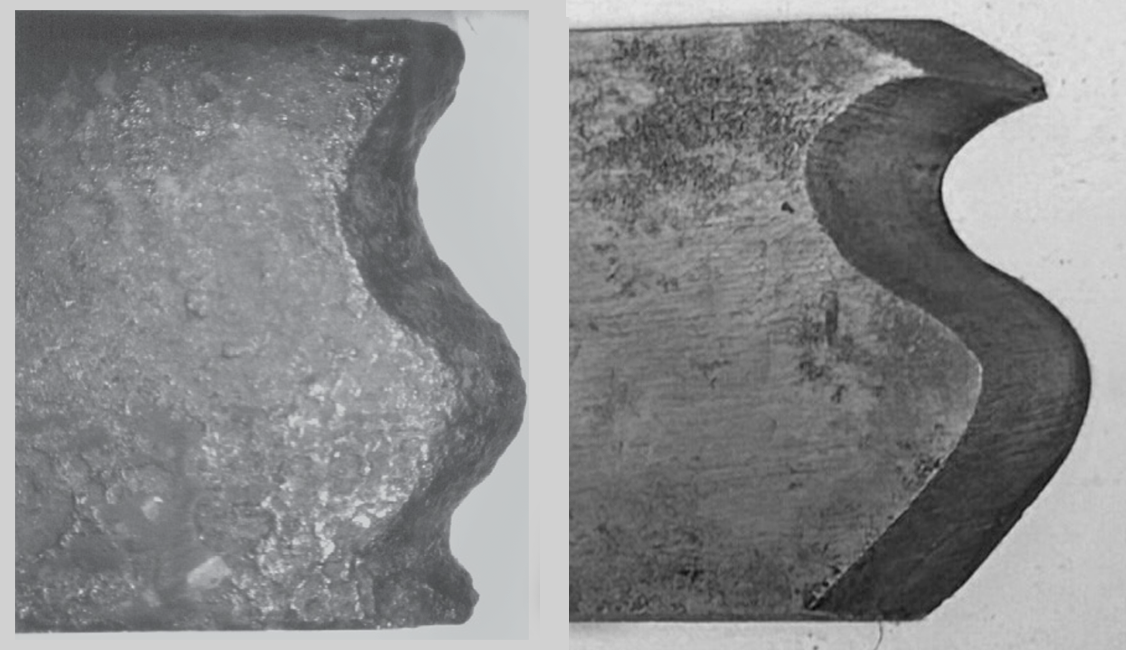 Left, a moulding iron (dated to between AD 160-180) found at Vindolanda in Northern England magnified 3x. Both it and the Trimontium blade are laminated steel and iron, like modern plane irons. Right, iron from a plane made by John Sym (London, England, active 1753-1801). Source: left, see note #5.
As to why so many moulding plane blades have been found in forts, the researchers who did a metallographic analysis of the blade from Vindolanda think it’s simply because forts were more likely to be vacated at short notice, with tools abandoned or thrown into wells to prevent them from being used by enemies. 5
The Roman aristocracy’s disdain for those who worked with their hands, including skilled labor, is well known. It’s one of the reasons we know almost nothing about the lives of individual Roman woodworkers. But they were well respected in their communities and had deep pride in their work. They regularly depicted themselves with their tools in carvings on their tombstones, an indication of how they thought of themselves and their craft, maybe even in distant corners of the empire. These tools etched in stone assert, as Ulrich writes, “unequivocally that the skilled ancient artisan wished to be remembered as such by those that survived him.”6
Moulding Irons Illustrations
- Trimontium: length 14.5 cm, cutting width 25.4 cm; James Curle, A Roman Frontier Post and its People (James Maclehose and Sons, 1911) 281.
- Vindolanda: length 12.2 cm, cutting width 2 cm; Sim, Vindolanda 77.
- Saalburg: length 18 cm; cutting width 1.8 cm; sharpening angle 26°; Pietsch, Saalburg.
- Saalburg length 23.4 cm; cutting width 1.6 cm; sharpening angle 44°; Pietsch, Saalburg,
- Saalburg length 20.4 cm; cutting width 2.7 cm; sharpening angle 38°; Pietsch, Saalburg.
- Zugmantel length 15 cm; cutting width 1.3 cm; sharpening angle 28°; Pietsch, Saalburg.
- London: (not from a fort) 15.2 cm; cutting width 1.3 cm; Owen Humphreys, London’s Roman Tools: Craft, agriculture and experience in an ancient city (BAR Publishing, 2021) 362.
Interested in more stories about moulding planes?

- Roman Soldiers and Their Moulding Planes
- The Ultimate Guide to Making Perfect Mouldings
- Planes on Roman Coins and Sticking Crown Molding
- How Fast Can You Plane 1,000 Feet of Moulding?
- The Last Marples Planemakers at Work
The story about Ohio Tool and the Webb Pattern Spur Rabbit Plane was originally published in this newsletter. It has since been moved to its own post: ‘I want to Knock this Man out of the Market’
-
Silke Lange, The Wooden Artefacts from the Early Roman Fort Velsen 1 (Cultural Heritage Agency of the Netherlands, 2021). ↩
-
Roger B. Ulrich, Roman Woodworking (Yale University Press, 2007) 7, 9, 178. ↩
-
range of tools: L. Jacobi, Das Römerkastell Saalburg Bei Homburg Vor Der Höhe (self-pub, 1897) 211. Note: Google Translate was used to translate this text. different woodworkers: Ulrich, Roman Woodworking 8. ↩
-
343: For more on the various professions working in that fabricae, see Alan K. Bowman and J. David Thomas, Vindolanda: The Latin Writing-Tablets (Society for the Promotion of Roman Studies, 1983) 77-78. prefabricated furniture…done onsite: Lange, Velsen 1 174, 178. Martin Pietsch: Martin Pietsch, “Die römischen Eisenwerkzeuge von Saalburg, Feldberg und Zugmantel,” Saalburg Jahrbuch 39 (1983). Note: Google Translate was used to translate this text. ↩
-
David N. Sim and Isabel M. L. Ridge, “Examination of a moulding plane blade from Vindolanda,” Historical Metallurgy 34 no. 2 (2000) 77-82. ↩
-
well-respected: One example comes from Apuleius’s Apologia, which describes a woodcarver and possible jointer, “a man whose skill is famous among his townsfolk and whose character is above reproach,” who did custom work. ↩